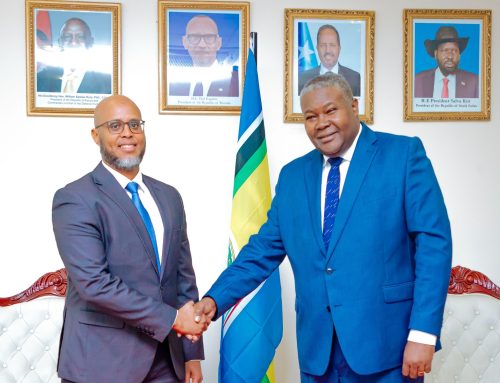

Juba, South Sudan23rd June 2026:- The East African Business Council (EABC), in collaboration with the South Sudan National Chamber of Commerce, Industry and Agriculture (SSNCCIA) and in partnership with GIZ, has enhanced the knowledge of over 45 South Sudanese enterprises on the African Continental Free Trade Area (AfCFTA) through a capacity-building workshop that commenced on 22 June 2026.
The enterprises represent a wide range of sectors, including manufacturing, agriculture and agro-processing, cosmetics, arts and crafts, trading, freight forwarding, transport and logistics, among others.
In his opening remarks, Mr. Weiu Weiu Mou, Second Vice Chairperson of the South Sudan National Chamber of Commerce, Industry and Agriculture (SSNCCIA), emphasized that the AfCFTA market presents significant opportunities for South Sudan to diversify its exports and expand its destination markets across Africa beyond the traditional markets of the East African Community (EAC) Partner States and the country’s oil exports.
He highlighted several products in which South Sudan has a comparative advantage and strong export potential under the AfCFTA framework, including shea butter, gum arabic, natural and organic honey, sesame seeds, groundnuts (peanuts), soybeans, and fish.
Mr. Weiu urged the Government of South Sudan to expedite the ratification of the AfCFTA Agreement and fully implement the EAC Common External Tariff (CET) so that the country can begin trading under the AfCFTA, like other EAC Partner States. He noted that although South Sudan was among the first countries to sign the Agreement, delayed ratification limits private sector access to the AfCFTA’s 1.3 billion consumer market.
Mr. Lamech Wesonga, Economic Policy Advisor on AfCFTA for the EAC, stated GIZ is committed to support private sector awareness of the AfCFTA Agreement and its Protocols to ensure businesses are well-positioned to utilize the framework once South Sudan ratifies the Agreement.
Mr. Adrian Njau, Trade and Policy Advisor at EABC, challenged the private sector to continue advocating for the Government to expedite ratification while simultaneously preparing themselves to trade under the Agreement. He noted that businesses should be ready to seize opportunities immediately upon ratification to compensate the seven years lost due to the country’s delay in ratifying the Agreement.
The three-day workshop focused on the AfCFTA Agreement, the Protocol on Trade in Goods and its Annexes, as well as the opportunities and challenges associated with accessing AfCFTA markets.
Enterprises also learned about key EAC trade instruments, including the EAC Common External Tariff (CET) and the Simplified Trade Regime (STR), which facilitates easier access to simplified certificates of origin and trade documentation for small-scale cross-border traders within the EAC.