By Ahmed Farah and Anja Berretta
Regional integration will not be possible without countries reducing barriers to trade, investment and movement of goods and services. However, a common economic space requires rules that are observed by everyone, even though not all Partner States, businesses or workers might benefit equally. How can this dilemma be resolved?
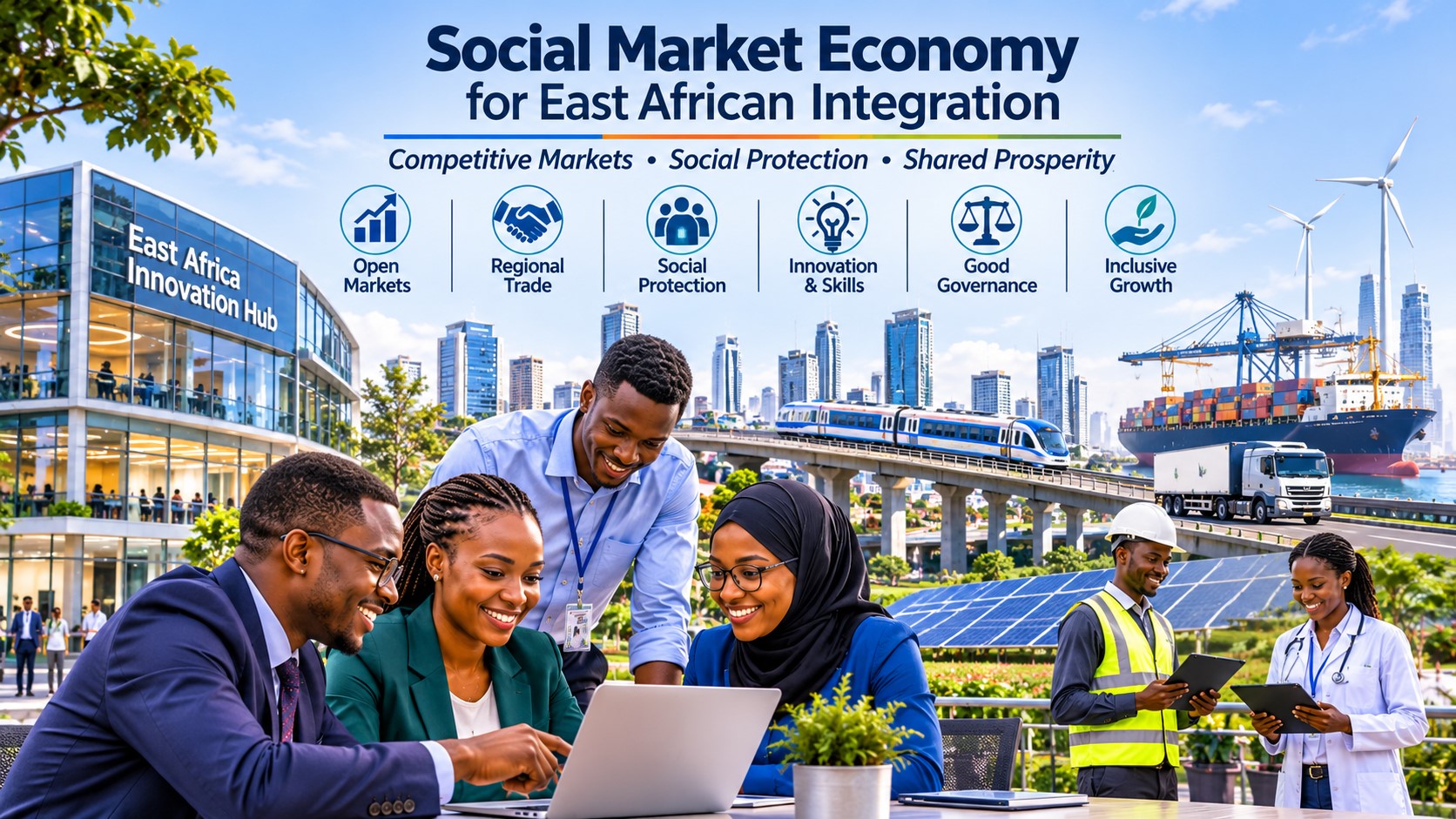
That is where the Social Market Economy model offers East Africa a useful starting point. The Social Market Economy seeks to combine the efficiency and innovation of a free market economy with instruments of social justice and social protection. The central idea is to leave as much freedom to the market as possible and reduce state intervention to where it is necessary.
The model relies on private ownership and fair competition to create wealth. Businesses decide what to produce and where to invest, responding to prices and demand.
The government guarantees an equal level playing field for all economic actors, assures that markets are open, and protects individuals against risks such as illness, unemployment or disabilities. At the same time, social support should help people to participate in economic activities and not create permanent dependency.
Developed in Germany, the model draws on ordoliberal thinking. Competition needs public institutions strong enough to defend it. Cartels can exclude new entrants, while political favouritism rewards connections over performance. That means protecting competition even when established businesses would prefer protection from it. When a business must depend on a personal connection to get things moving, something is wrong.
People also need a reasonable chance to participate. Education and skills matter, as does protection against illness or loss of work. Solidarity makes that a shared responsibility. Subsidiarity leaves decisions with individuals, businesses and communities where they can manage them, with public support where needed. Both principles affirm human dignity and personal responsibility.
The East African Community (EAC) Treaty provides for people-centred, market-driven cooperation. The Customs Union and Common Market Protocols turn that ambition into agreed commitments to open economies and remove barriers between Partner States. Their value depends on implementation. Private enterprise turns those commitments into investment and jobs. A larger market gives firms room to specialise, expand and diversify production, and build supply chains across borders.
The Common External Tariff (CET) sets duties on imports from outside the EAC. Its sensitive list in Schedule 2 identifies products for special tariff treatment, including higher duties to protect regional agricultural and industrial production. Partner States have already provided for this protection within their common tariff.
Stays of application allow individual Partner States to depart from the common rates with Council approval. Repeated reliance on them fragments the tariff regime and leaves firms competing under different conditions. That defeats the spirit of integration. We should end routine reliance on stays and apply the agreed CET, including its sensitive list, consistently. Where changes are needed, Partner States should review the common framework together, using evidence on regional production and costs to consumers.
Making common rules work requires the EAC Secretariat to coordinate implementation, monitor progress and bring unresolved issues to the Council of Ministers. Partner State governments must put agreed protocols and decisions into practice through their laws and agencies. The Secretariat needs their backing and the resources to do its job.
As foreseen in the Social Market Economy, the state should temporarily support those who might not benefit fully from regional integration, for instance workers who lose jobs as markets open. Introducing policies that aim to enhance the competitiveness and productivity of firms is a key state responsibility. However, keeping inefficient business permanently protected via subsidies or other mechanisms can deplete state budgets and keep prices artificially high, making consumers, other businesses and citizens pay for that protection.
Business has obligations too. Firms seeking access to their neighbours’ markets must accept competition at home. A demand for fair rules loses credibility when it comes with requests for exemptions that suit one firm alone. Paying taxes, meeting environmental obligations and treating workers fairly belong to the same responsibility of contributing to the common good.
Government establishes and enforces the rules of the market, while businesses drive investment, innovation, job creation, and economic growth. For business associations such as the East African Business Council (EABC) and industry federations, as well as for corporations, SMEs and entrepreneurs, the task is to bring evidence from firms into decisions on tariffs, standards and market access. This evidence is important for policymakers to understand regulatory bottlenecks, supply chain challenges, skills shortages and infrastructure needs.
Effective economic policymaking benefits from input from those who operate in the markets. In the East African context, governments can negotiate agreements and remove barriers, but businesses ultimately trade across borders, build regional value chains, invest in production, create employment, and develop new markets. As a result, successful regional integration depends on continuous dialogue between policymakers and the private sector.
 |
 |
| Ahmed Farah is Executive Director of the East African Business Council (EABC). | Anja Berretta is Head of the Regional Programme Economy Africa at Konrad-Adenauer-Stiftung (KAS). |