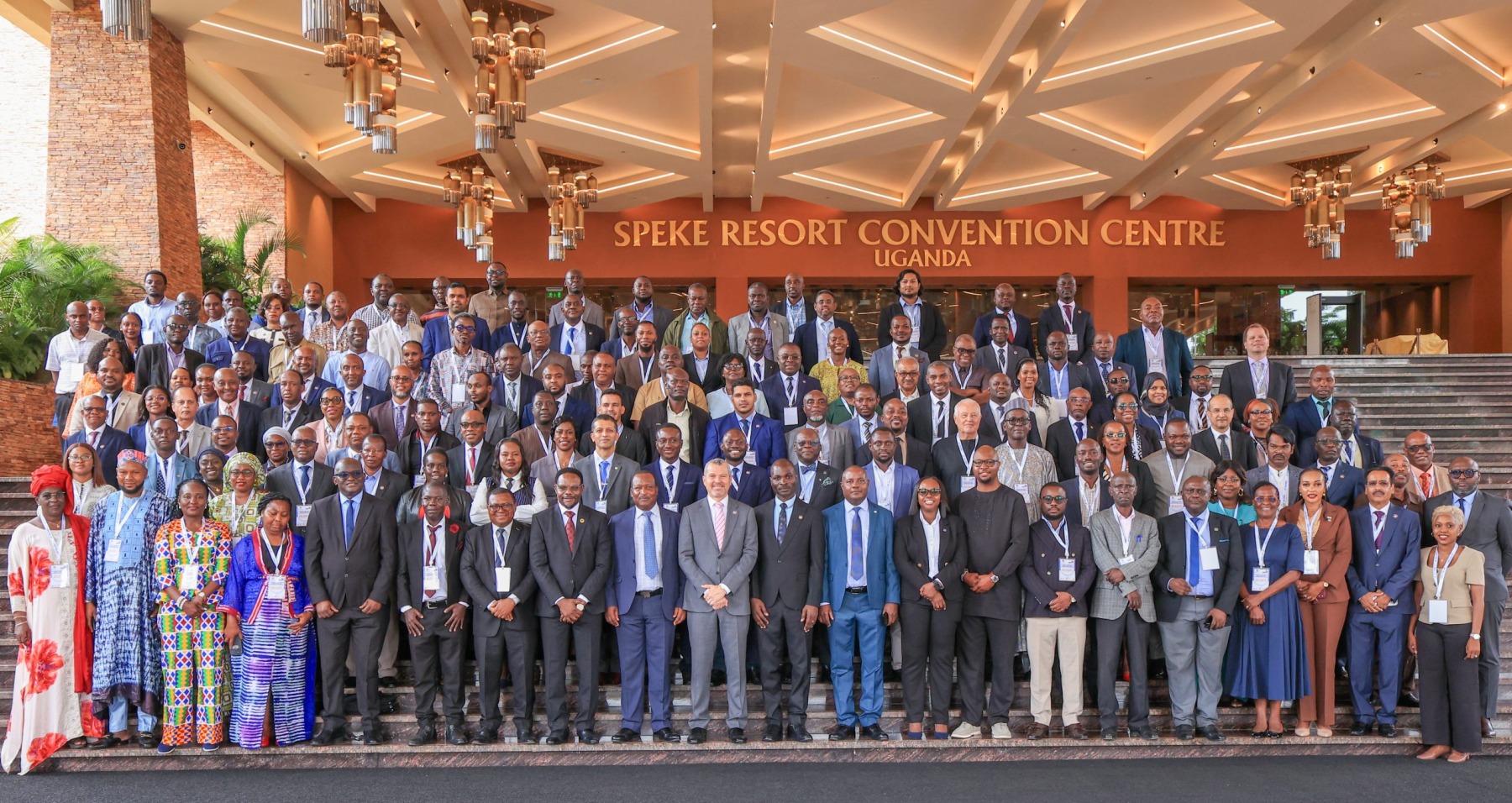
Kampala, Uganda, 17 November 2026. African maritime leaders meeting in Kampala agreed that the continent has enough maritime policies; what it lacks is putting them into practice. The East African Business Council (EABC) Executive Director, Mr. Ahmed Farah, told delegates that progress should be measured by what businesses experience: the cost, time and reliability of moving cargo.
Mr. Farah was a panellist at the 9th Conference and General Assembly of the Association of African Maritime Administrations (AAMA). The conference was held at Speke Resort Munyonyo from 17 to 19 November 2026, hosted by Uganda’s Ministry of Works and Transport, and attended by delegates from more than 60 countries. Its theme was “From Policy to Practice: Advancing Africa’s Maritime Transformation through Effective Governance, Innovation and a Sustainable Blue Economy.”
Uganda’s Minister for Works and Transport, Hon. Fred Byamukama, formally opened the conference. He noted that the Revised African Maritime Transport Charter was adopted in Kampala in 2010, and that Uganda’s ratification brought it into force. He cited upgrades at Port Bell and Jinja Port, the new Bukasa Port on Lake Victoria, rehabilitation of the Metre Gauge Railway and development of the Standard Gauge Railway. He also called for AAMA to be formally recognised within the African Union.
AAMA Chairperson Mr. Omae Nyarandi named five priorities for the conference:
- Decarbonisation
- Digitalisation
- Governance and diversity
- Seafarer development
- Intra-African trade carried by sea
IMO Secretary-General Mr. Arsenio Dominguez commended Uganda’s work on inland waterways, multimodal links and the Maritime Single Window as an example for other regions. He urged administrations to treat IMO audit findings as a basis for requesting technical assistance. He also warned that conflicts in the Red Sea, the Black Sea and around the Strait of Hormuz affect African economies through energy, fertiliser and grain supplies.
The AAMA Secretariat reported that Africa has plenty of maritime investment ideas but few bankable projects. Financiers need feasibility studies, sound risk allocation and predictable regulation. The Secretariat also reported that only 16 African Union member states have deposited AAMA’s institutional instrument.
The Panel on Regional Cooperation examined how regional institutions can harmonise maritime policies, strengthen cross-border coordination and address overlapping mandates and limited institutional resources.
The discussion highlighted growing support among African countries, including land-linked states, for a coordinated maritime agenda. More than 23 countries have adopted a feasibility study for a regional shipping line network, supported by a regional cabotage framework. Participants called for more efficient intra-African shipping routes, noting that cargo traded between neighbouring countries should not have to travel overseas and back.
The panel also highlighted plans for a regional maritime university to address fragmented and under-resourced training institutions, alongside the development of model regional merchant shipping legislation. Participants called for stronger institutional alignment and a whole-of-government approach to maritime development.
On regional connectivity, the Central Corridor was highlighted as an example of cooperation linking seven countries—Burundi, the Democratic Republic of the Congo, Malawi, Rwanda, Tanzania, Uganda and Zambia—to international markets through the Port of Dar es Salaam. Trade facilitation measures include an electronic single window, deployment of member-state customs officers at the port, dry ports and One-Stop Border Posts, which have reduced border delays by more than 60 per cent.
The discussion emphasised that corridor performance should be measured by the reliability and efficiency of cargo delivery, rather than port operations or regional agreements alone. Regional institutions were urged to address practical bottlenecks, clarify responsibilities and monitor progress against measurable performance indicators.
From the private sector perspective, EABC Executive Director Mr. Ahmed Farah underscored that multiple agencies involved in clearing a single container increase business costs and cause delays. He noted that intra-African trade accounts for approximately 17 per cent of the continent’s total trade, while intra-EAC trade stands at about 12.5 per cent. He cautioned that “AfCFTA tariff preferences will not matter if market access, intermodal links, corridor performance and regulatory harmonisation are not addressed.”
He further emphasised that regional maritime cooperation is an economic necessity for businesses, stating: “For business, regional maritime cooperation is no longer a nice-to-have. It is literally a must.” He called for structured private sector participation in regional maritime coordination to ensure that business experiences inform policy and reform implementation.
The panel also highlighted EABC’s inaugural Trade and Investment Climate Report, launched on 17 September 2026 by Rt. Hon. Rebecca Kadaga, Chairperson of the EAC Council of Ministers. The report identifies ten priority reform agenda items, which EABC will track through its annual EAC Investment Forum, reporting on resolved barriers and the institutions responsible for outstanding reforms.
The panel was moderated by Ms. Issa Majitta, IMO Head of Africa, and featured the Secretary-General of the Maritime Organisation for Eastern, Southern and Northern Africa, Mr. Charles Khalinda of the Central Corridor Transit Transport Facilitation Agency, and Mr. Ahmed Farah, Executive Director of EABC.
Panel on Governance: From Commitment to Implementation examined why the ratification of international maritime conventions does not always translate into effective national implementation.
The discussion highlighted institutional fragmentation, outdated legislation and gaps in enforcement as major obstacles. One example cited was a country where maritime responsibilities were previously spread across 21 government agencies under a shipping law modelled on an 1895 English Act. The panel emphasised the need to shift the focus from policy commitments to institutional performance and implementation.
Tanzania’s experience demonstrated the importance of early engagement with the Attorney General’s Office in accelerating ratification and domestication. The country has domesticated approximately 21 conventions through more than 36 regulations and increased its flag and port state control officers from 24 to 64. Nigeria highlighted formal cooperation agreements with its Navy and training partners, alongside its Deep Blue maritime security project, through which more than 2,000 seafarers have reportedly been trained.
The discussion also exposed gaps in enforcement, including Ghana’s maritime offences legislation, where the principal Act is in place but subsidiary regulations required for enforcement remain outstanding. The IOPC Funds further stressed that access to oil spill compensation depends on appropriate implementing legislation, designated national focal points and accurate incident records.
The panel elaborated that ratification must be accompanied by domestic legislation, institutional capacity, enforcement mechanisms and effective inter-agency coordination.
Panel on Building Africa’s Maritime Workforce examined the challenges facing Africa in developing a skilled and competitive maritime workforce, particularly access to practical training, sea-time placements and employment opportunities.
The discussion highlighted a shortage of vessel berths for cadets to obtain the required sea-time experience rather than a lack of trainees. One maritime university in Ghana reported having approximately 700 cadets against residential accommodation capacity of 250, illustrating the growing pressure on training infrastructure.
Participants also highlighted the challenges of sustaining cadet placement programmes, with some placements under international industry partnerships having been cut short due to funding constraints. From the shipping industry’s perspective, limited familiarity with African maritime talent and reliance on established recruitment markets continue to constrain employment opportunities. Greater transparency, good governance and direct engagement between African institutions and shipowners were identified as important steps towards building confidence.
The panel recommended establishing regional centres of excellence equipped with maritime simulation facilities to strengthen practical training. It also highlighted the need to improve seafarers’ awareness of their rights and protections under the Maritime Labour Convention, noting that approximately 30 per cent of seafarers surveyed by the World Maritime University were unaware of their rights.
The overarching message was that Africa must invest not only in maritime education and training but also in sea-time opportunities, sustainable industry partnerships and pathways to employment to develop a competitive maritime workforce.