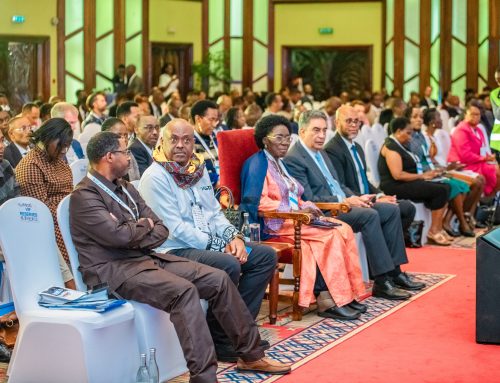

Thursday, 11 June 2026 | Kigali, Rwanda: Over 50 entrepreneurs in Rwanda have enhanced their knowledge of the African Continental Free Trade Area (AfCFTA) Agreement Protocol on Trade in Goods following the EABC–GIZ Private Sector Sensitization Workshop held from 8–10 June 2026.
The women-led enterprises were drawn from the leather, cosmetics, arts and crafts, transport, agro-processing, and manufacturing sectors.
Delivering her remarks, Ms. Gloria Mutoni from the Ministry of Foreign Affairs and International Cooperation of the Government of Rwanda emphasized the importance of regional integration and continued government support for private sector development.
Mr. Sylvester Malowa from GIZ underscored the important role of the private sector in driving AfCFTA implementation.
Delivering remarks on behalf of Mr. Ahmed Farah, Executive Director of the East African Business Council (EABC), Mr. Adrian Njau, Trade and Policy Advisor at EABC, noted that the AfCFTA is expected to boost intra-African trade through the gradual elimination of tariffs on over 90% of goods and the reduction of non-tariff barriers. He reaffirmed EABC’s commitment to supporting SMEs and strengthening public–private dialogue to unlock the potential of the continental market of 1.3 billion consumers.
SMEs often face costly and complex compliance requirements and are frequently subjected to the same regulatory burdens as large firms. The enterprises called for simplified, SME-friendly procedures, reduced logistical challenges, enhanced business matchmaking, and harmonized standards to reduce certification duplication.
The workshop focused on AfCFTA opportunities, market access, rules of origin, trade facilitation, and practical strategies for expanding into African markets, while also highlighting the use of the Simplified Trade Regime (STR) for duty-free cross-border trade and digital information tools and platforms such as the African Trade Observatory and the Africa Trade Gateway.
Participants further explored in detail the Annexes to the AfCFTA Protocol on Trade in Goods, including Annex 1 on Schedules of Tariff Concessions, Annex 2 on Rules of Origin, Annex 3 on Customs Cooperation and Mutual Administrative Assistance, Annex 5 on Non-Tariff Barriers (NTBs), Annex 6 on Technical Barriers to Trade (TBT), Annex 7 on Sanitary and Phytosanitary (SPS) Measures, Annex 8 on Trade Remedies, and Annex 9 on Transit.